Skip to content
Client PortalArtist PortalPartner Portal
pyxartis
For working artists

Your original may sell once. Its digital master can work for you for decades.

pyxartis creates museum-grade, color-accurate digital masters of original artwork — for prints, portfolios, galleries, licensing, publication, archival records, and everything that comes after the original leaves your studio.

Discovery call

Book a discovery call.

See Pricing
Color-matched
Every master compared against the original
Capture depth16-bit
$185Per artwork
Phase OneCapture
16-bitMaster
Volume pricing
Preferred Artist Program
Phase One captureControlled studio lightingColor-managed workflowMatched against the original16-bit archival mastersPrint-ready filesVolume pricing for artistsPhase One captureControlled studio lightingColor-managed workflowMatched against the original16-bit archival mastersPrint-ready filesVolume pricing for artistsPhase One captureControlled studio lightingColor-managed workflowMatched against the original16-bit archival mastersPrint-ready filesVolume pricing for artists
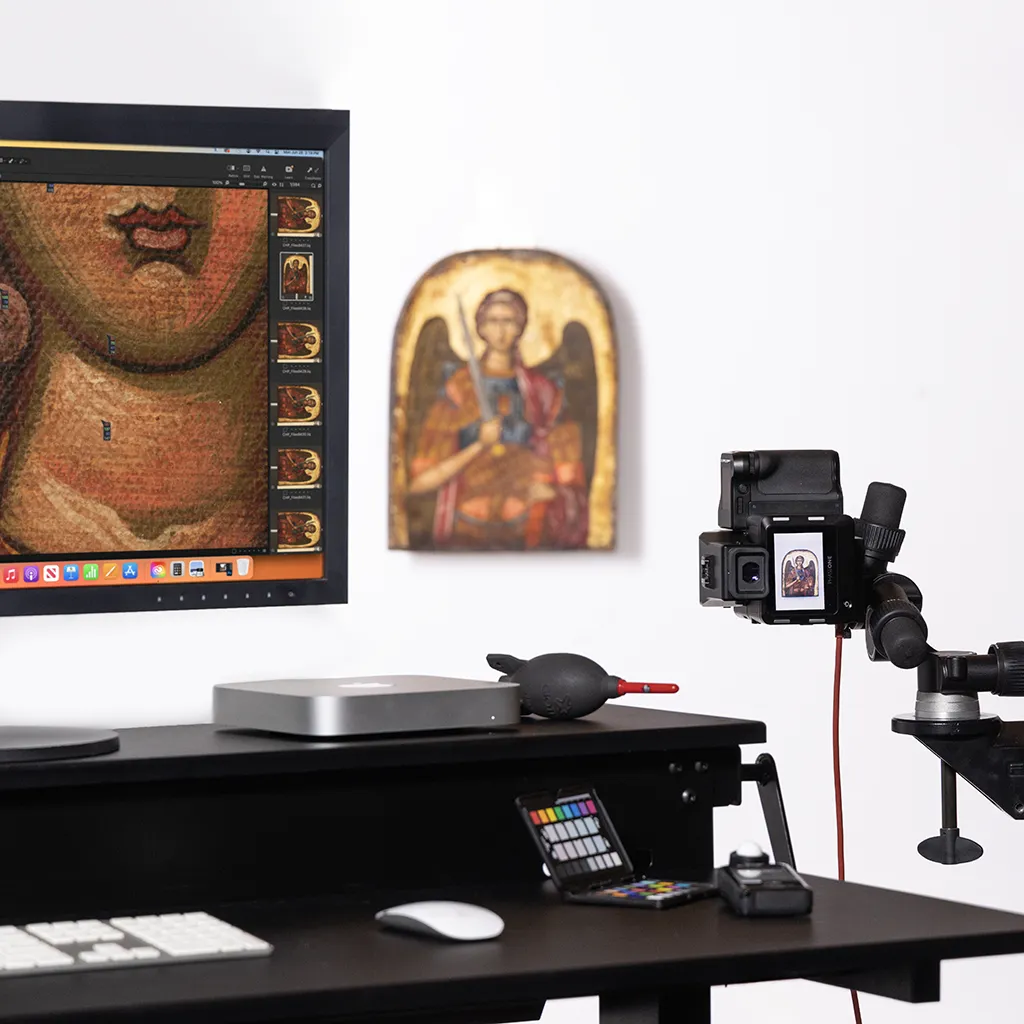
Artwork positioned on the capture wall while a medium-format camera records it under even, controlled light

Why it matters

A phone photo documents your painting.A pyxartis master preserves what you actually made.

We are not simply photographing a painting. We are making a museum-grade, color-accurate digital master of your original work — captured on the same Phase One system and the same color-managed pipeline museums and collections use, then checked against the piece in front of us. It is the file everything else is built from: the prints, the portfolio, the submission, the license, the record of a work you no longer own.

Museum-grade artwork digitization

One original. Dozens of possibilities.

A painting can hang in one room at a time. Its digital master can be everywhere at once — and it keeps working long after the original has been sold, shipped, or hung somewhere you'll never see it again.

Sell it more than once

An accurate master is what archival giclée prints, limited editions, and gallery sales material are made from. The original sells once; the edition can sell for years.

Show it everywhere

Galleries, competitions, grants, and exhibition juries all judge from images. Consistent, color-true portfolio files mean your work is assessed on the work — not on the photography.

Keep it after it's gone

Licensing, editorial and publication requests, and the record of a sold original all depend on a file made before the piece left the studio. Digitize a body of work and you have an archive, not a folder of snapshots.

  • Archival giclée prints
  • Limited editions
  • Exhibition submissions
  • Portfolio imagery
  • Gallery sales material
  • Licensing assets
  • Editorial & publication files
  • Website & social imagery
  • Historical documentation

The quality difference

The file should look like the painting.

Most artwork photography drifts — a little warm, a little flat, highlights clipped where the impasto catches the light. Our workflow exists to remove that drift. Every stage is measured, and the last measurement is the one that matters: the file, next to the artwork, under known light.

  • Phase One medium-format capture

    A 151 MP medium-format sensor on Schneider optics, recording 16 bits per channel. Enough resolution and tonal room that an enlargement holds up — and enough latitude that deep darks and bright passages both keep their detail.

  • Controlled studio lighting

    Even, polarized, repeatable light across the whole surface. No hot spot in the middle, no falloff at the edges, no reflection sitting on top of a varnished passage.

  • Calibrated, color-managed workflow

    Every device in the chain is profiled and speaks the same color language, and capture is referenced to a physical target — so the numbers in the file mean something before anyone's eye is involved.

  • Color matched against the original

    The file is compared against your artwork, in the room, and adjusted until they agree. This is the step most artwork photography skips, and it is the one artists notice.

  • A high-resolution 16-bit archival master

    Texture, tonal range, subtle color shifts, and surface detail all preserved at full size — a file built to be printed from, licensed from, and returned to years from now.
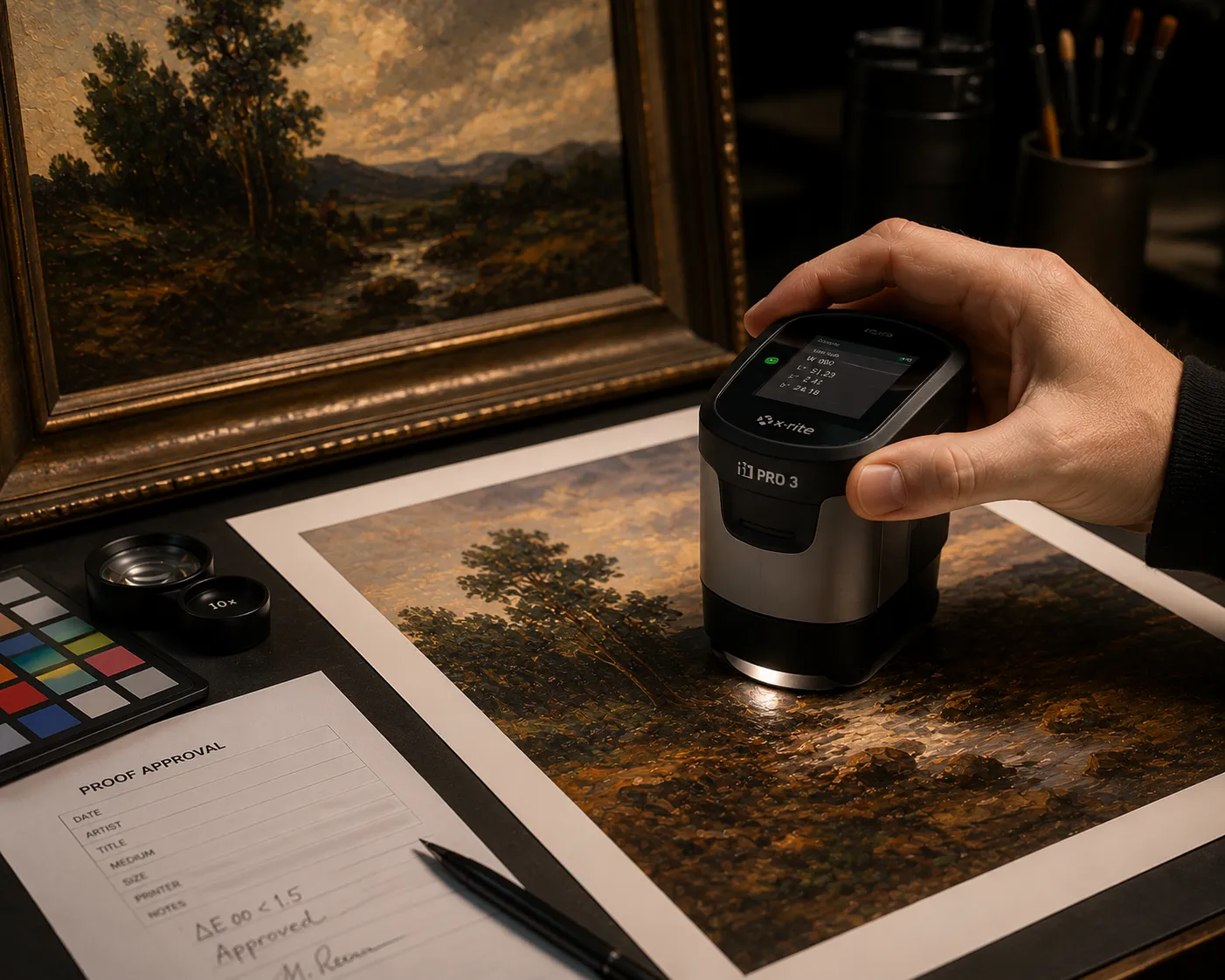
A spectrophotometer measuring color directly against an original artwork

What we don't do

We are not improving your artwork. We are translating it faithfully.

Retouching is not part of artwork digitization. We do not brighten, saturate, straighten a line, or clean up a passage you left the way you left it. The goal is a faithful reproduction of the original — every decision you made, recorded as you made it. If a piece is damaged or a legacy work needs repair, that is our separate digital restoration service, quoted on its own.

Pricing

Priced per artwork, not per project.

Two capture rates, set by how much handling the work needs — with volume pricing for artists digitizing several pieces at once, and a stitched-capture add-on for work that needs more resolution than a single frame holds. Every rate covers capture and digital delivery.

Capture-ready work

Standard Artwork Capture

$185per artwork

Framed, stretched, mounted, rigid, or otherwise capture-ready artwork — work that can go on the capture wall as it arrives.

  • Professional Phase One capture
  • Controlled studio lighting
  • Color matching against the original
  • High-resolution digital master
  • Standardized file delivery

Volume pricing

  • 1 – 4 pieces$185 each
  • 5 – 14 pieces$170 each
  • 15 – 29 pieces$155 each
  • 30+ piecesCustom project quote

Extra handling

Complex Artwork Capture

$385per artwork

Unstretched canvas, rolled artwork, oversized works, and pieces needing flattening, weighting, overhead capture, specialized positioning, or substantially more handling.

  • Everything in Standard Artwork Capture
  • Flattening, weighting, and specialized positioning
  • Overhead or non-standard capture setups
  • Additional handling and preparation time
  • Setup planned before your work arrives

Volume pricing

  • 1 – 4 pieces$385 each
  • 5 – 14 pieces$365 each
  • 15 – 29 pieces$345 each
  • 30+ piecesCustom project quote

Add-on

Stitched High-Resolution Capture

For artwork requiring resolution beyond a single Phase One capture, we photograph the artwork in multiple overlapping sections and combine them into a single ultra-high-resolution digital master.

Your capture rate + $45

per additional capture

What's included

Professional color matching is included in every capture. Retouching is not — artwork digitization is a faithful translation of the work, not an alteration of it. Rates cover capture and digital delivery; printing and reproduction are quoted separately.

Which rate applies

Most work falls cleanly into one of the two rates, and we confirm which one before any capture begins. Pieces that need custom rigging, unusual substrates, or a setup beyond our standard complex capture are quoted individually rather than assumed into a listed rate — as are bodies of work of 30 pieces or more.

Not sure which rate your work falls under? Send us dimensions and a snapshot — we'll tell you.

Discovery call

Book a discovery call.

For artists working at volume

pyxartis Preferred Artist Program.

For professional artists with ongoing monthly capture needs, pyxartis offers preferred pricing and a more streamlined studio relationship — the same color-managed workflow, running on a standing rhythm instead of a new project every time.

Studio relationship

  • Priority scheduling
  • Faster turnaround when capacity allows
  • Simplified recurring booking
  • A simplified monthly workflow
  • A dedicated artist account
  • A consistent pyxartis team familiar with your work

Color & files

  • A consistent color-management workflow
  • Your own artist color and capture profile
  • Consistent file standards across every session
  • Standardized file naming and delivery
  • A running digital archive and capture history

Pricing & terms

  • Preferred member pricing
  • Predictable production costs
  • Volume flexibility within an agreed range
  • Preferred access to additional reproduction services
  • No membership fee

Designed for artists with consistent recurring artwork volume. Applying creates your pyxartis account at the same time — there is no fee, and no obligation if the rates don't suit.

Apply to the Program

Discovery call

Book a discovery call.

Already have an account? Sign in to the artist portal.

The process

From your studio to your digital master.

Four steps, and you are only involved in two of them.

1. Bring or ship your artwork

Denver artists work with us locally at the lab. Artists anywhere else in the country can contact us about shipping — we'll talk through packing and timing before anything moves.

2. We prepare and capture

Your artwork is positioned, lit, calibrated, and photographed on our color-managed capture workflow — even light across the surface, no reflections, nothing clipped.

3. We color-match the master

The file is compared against the original so color, tone, and detail stay faithful to the work. This is the step that makes it a master rather than a photograph.

4. You receive your digital master

Use it for prints, archives, portfolios, galleries, publishing, licensing, and any future reproduction. The file is yours to work from for as long as you need it.

Canon imagePROGRAF PRO-6100 large-format printer producing an archival giclée print

For artists who sell prints

Capture it once. Reproduce it whenever you're ready.

Digitization makes the master. Fine art reproduction is what happens next — archival giclée on cotton rag or canvas, textured relief that carries the brushwork, editions produced from the same file, months or years apart, without the original ever coming back out of storage.

Original artwork → museum-grade digital master → reproductions. You only have to do the first two once.

Denver & Colorado

Artwork digitization in Denver.

The lab is at 209 Kalamath St Unit 1 in Denver's Santa Fe Arts District, and Colorado artists work with us directly: bring the work in, see it on the capture wall, and stand next to the file while it is matched against the original. That last step is the one most artwork photography skips, and it is a great deal easier to trust when you watched it happen.

Front Range studios — Boulder, Golden, Littleton, Fort Collins, Colorado Springs — are a comfortable drive, and larger bodies of work can be collected rather than carried. Here is what a visit looks like.

Being somewhere else costs you nothing. Artists across the country ship work to the Denver lab, and the capture, the color matching, and the master are identical either way. For a body of work too large or too fragile to travel, the capture setup comes to your studio instead.

Not sure which of those fits? Tell us where you are and what you are digitizing, and we will tell you.

Three ways to work with us

Local, national, or onsite anywhere in the world.

Locally, in Denver

Colorado clients drop off and collect in person at our Denver lab, review samples, and meet the team. By appointment.

Visit the lab

By shipment, nationwide

Clients across the U.S. ship film, artwork, prints, and archival materials to the lab — tracked and insured — for scanning, reproduction, and documentation.

Start an artwork project

Onsite, worldwide

For major museum, estate, gallery, and cultural-heritage projects, we bring the lab to your collection anywhere in the world.

Onsite preservation

Frequently asked questions

What kinds of artwork can you digitize?
Paintings in oil, acrylic, gouache, and watercolor; drawings and works on paper; prints and monotypes; photographs; textiles and mixed media; and three-dimensional pieces on request. If you're unsure whether something is a good fit — an unusual substrate, a heavy assemblage, a piece with a fragile surface — send dimensions and a snapshot and we'll tell you before you make any arrangements.
Do you photograph framed artwork?
Yes. Framed work is regularly captured as it arrives. The frame itself can be included or cropped out, whichever you need — just tell us which when we scope the session.
Can you digitize artwork behind glass?
We can, and polarized lighting removes most of what glazing throws back at the camera. The most faithful master still comes from capturing the work unglazed, because glass and acrylic both affect color and micro-detail no matter how well the reflections are controlled. If the glazing can be removed safely, we recommend it; if it can't, tell us and we'll plan the capture around it.
What about unstretched or rolled canvas?
That's what Complex Artwork Capture is for. Unstretched and rolled work needs flattening, weighting, and often overhead capture rather than the standard capture wall. Let us know in advance so the setup is ready when your work arrives.
Do you retouch my artwork?
No. Retouching is not part of artwork digitization, and it isn't quietly included. We don't brighten, saturate, straighten, or clean up the work — the goal is a faithful translation of what you made. Damaged or faded pieces that genuinely need repair are handled by our separate digital restoration service, scoped and quoted on its own.
How accurate is the color?
Every device in our chain is profiled, capture is referenced to a physical color target, and the resulting file is then compared against your artwork before delivery. That last step — color matching against the original, in the room — is what separates museum-grade artwork digitization from color-accurate-looking photography, and it's included in every capture.
Why does 16-bit color matter for artwork digitization?
Our Phase One system captures at 16 bits per channel, where the professional DSLR and mirrorless cameras used for most artwork photography capture 14. A 14-bit file describes 16,384 tonal values per color channel; 16-bit describes 65,536. Across the red, green, and blue channels together, that is roughly 4.4 trillion possible color combinations at 14-bit against 281.5 trillion at 16-bit — 64 times more color information, or about 277 trillion additional combinations. For artwork it matters where the differences are smallest: subtle gradients, shadow detail, glazing, brushwork, and surface texture. It also leaves far more latitude for color correction and print preparation without banding or tonal artifacts, so the master carries as much of the original's tonal and color information as the capture can hold.
What files do I receive?
A high-resolution 16-bit archival master, delivered through our client portal. If you need specific sizes, color spaces, or file types for a gallery, printer, publisher, or competition portal, tell us what they've asked for and we'll include it in the delivery.
What resolution are the final digitized artwork files?
Artwork is captured on a Phase One XF IQ4 medium-format camera system, producing files up to 14,204 × 10,652 pixels — roughly 151 megapixels from a single frame. Work that needs more resolution than one frame holds is captured in overlapping sections and stitched, which lifts the ceiling well past that.
Can you capture artwork at higher resolution than a single frame?
Yes — that's Stitched High-Resolution Capture. We photograph the work in multiple overlapping sections and combine them into a single ultra-high-resolution master, so a piece isn't limited to the roughly 151 megapixels one Phase One frame holds. It's an add-on to whichever capture rate your work falls under, at $45 per additional capture, and we work out how many sections a piece needs before any capture begins.
What DPI are the final files?
Master files can be delivered at 300 DPI, the standard resolution for professional fine-art printing, publishing, reproduction, and archival use. At full native resolution, a 14,204 × 10,652-pixel image corresponds to about 47.35 × 35.51 inches at 300 DPI, with no interpolation or artificial enlargement.
Can the files be used for large-format reproductions?
Yes. With roughly 151 million pixels in the original capture, the files leave substantial room for large-format printing, detailed crops, books, catalogs, archival reproduction, and other high-resolution uses. Exact maximum print size depends on viewing distance, print process, and what the reproduction itself requires.
Can I use the files to make prints?
Yes — that's a large part of why the master exists. Print with us through our fine art reproduction service, or take the file to a printer you already work with. Either way it's built to be printed from at scale.
Do you offer volume pricing?
Yes. Both capture rates drop as the piece count rises — the tiers are published in the pricing section above, from 1–4 pieces through 15–29. Bodies of work of 30 pieces or more are scoped as a custom project so the quote reflects what the work actually needs.
What is the Preferred Artist Program?
A standing studio relationship for professional artists with ongoing monthly capture needs: preferred member pricing, priority scheduling, a consistent color and file standard across sessions, a dedicated account, and a running archive of your capture history. There is no membership fee. Rates are set when we scope your typical volume. You can apply from the program section above — it creates your pyxartis account and files the application in one step, and we come back to you within a couple of business days.
Can I ship my artwork to you?
Yes — we work with artists across the country who ship work to the Denver lab. Get in touch before you send anything so we can talk through packing, insurance, timing, and the return trip.
Do I need to be in Denver?
No. Denver and Colorado artists work with us directly at the lab, artists anywhere in the U.S. ship their work in, and for larger bodies of work we can bring the capture setup to you. Contact us with where you are and what you're digitizing.
How large an artwork can you capture?
Large work is routine, and oversized pieces are part of what Complex Artwork Capture covers. The practical limit depends less on a single dimension than on how a piece can be positioned and lit safely, so send us the dimensions and we'll confirm what's possible before you commit to anything.

Your artwork deserves a master as carefully made as the original.

Create a color-accurate digital master before the original sells, ships, or leaves your studio.

Discovery call

Book a discovery call.

Apply to the Preferred Artist Program